Bryophilous, bryicolous, bryosymbiotic, bryoparasitic… What does it all mean?
These definitions and discussion points are not published / set in stone and you may disagree with them. I provide my opinions as to what these terms mean and what biodiversity they encompass.
Bryophilous and bryicolous
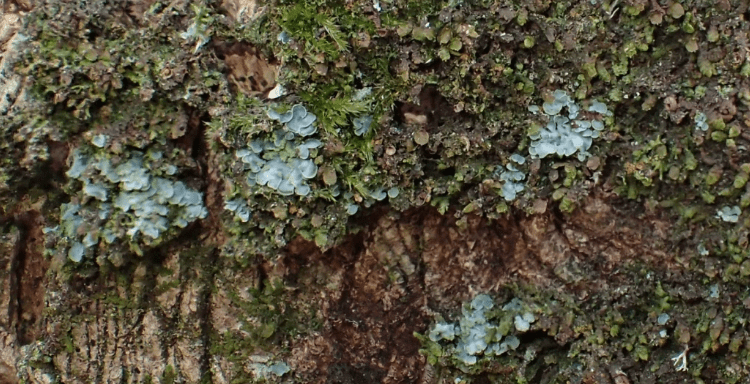
Bryophilous fungi refer to those which require bryophyte hosts, either as preferential substrates (platforms upon which to grow) or as hosts from which nutrients are directly derived. This encompasses fungi such as Octospora, which parasitise bryophytes, but also those like the lichen Protothelenella petri, which frequently grow on bryophytes as micro-epiphytes.
In lichenological communities, bryicolous is sometimes used and appears to generally refer to lichens that grow on or with bryophytes, not necessarily indicative of strict nutritional or substrate preferences, but rather the sharing of niches.
These definitions are somewhat broad and open-ended. For example, several lichens I would describe as bryophilous are not strictly confined to bryophytes as substrates, but are tiny and often overlooked on non-bryophyte substrates by lichenologists.

Bryosymbiotic
Stenroos et al. (2010) stated that they prefer to use the term bryosymbiotic, citing de Bary’s 1878 paper on symbiosis as their justification. This definition, although not explicitly stated in their paper, corresponds with my above definition of bryophilous. My understanding is that it encompasses those fungi that have “intimate” relationships with bryophytes, inclusive of lichenised and non-lichenised fungi. While symbiosis is sometimes misinterpreted to only include organisms in mutualistic relationships (where both host and symbiont benefit), it also includes parasites (host is detrimentally affected) and commensals (host is generally unaffected, symbiont benefits).
Bryosymbiotic is perhaps a better definition of what I call bryophilous fungi than bryophilous is, as it immediately suggests intimacy and specificity, filtering out other fungi that happen to grow in the proximity of bryophytes.
Bryoparasitic
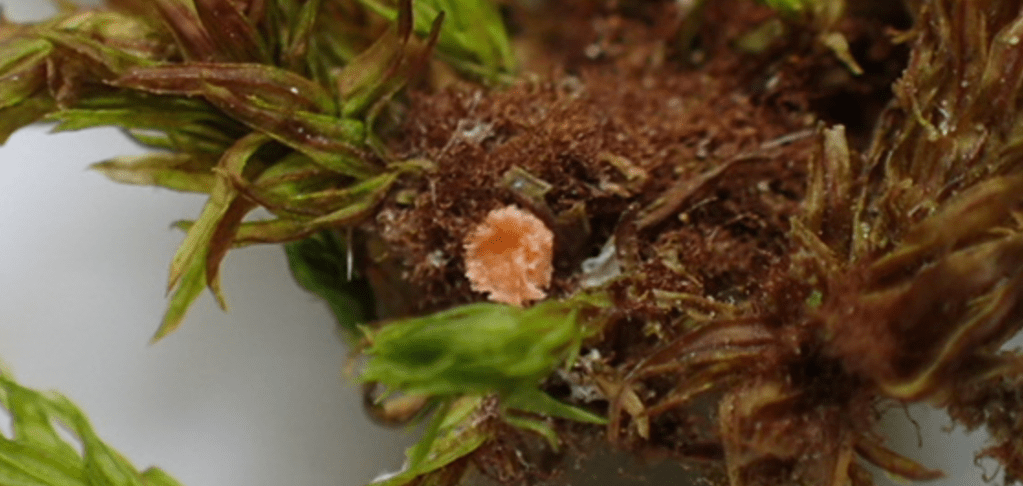
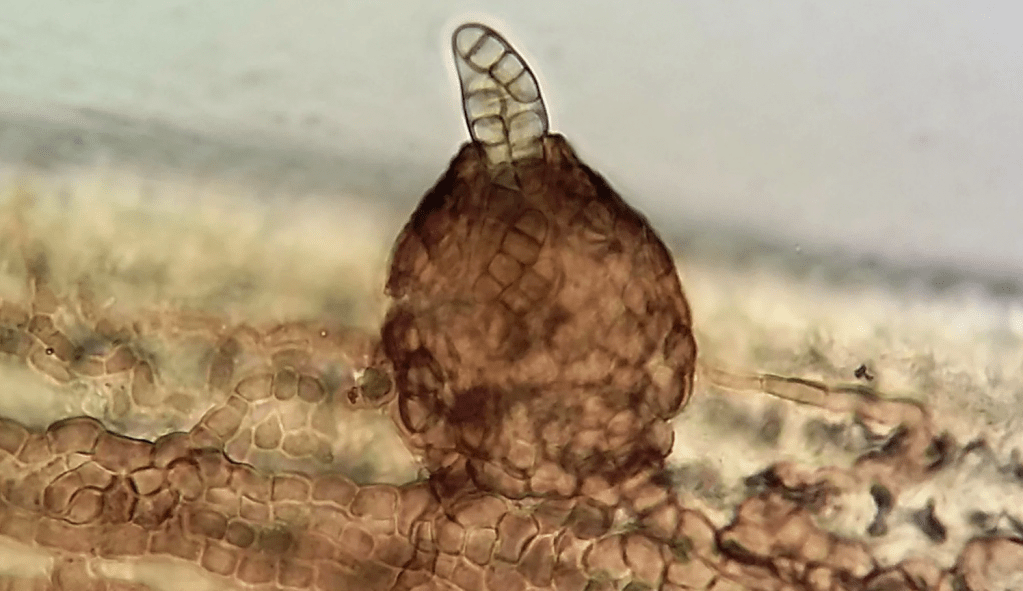
Bryoparasitic fungi are a subset of bryophilous / bryosymbiotic fungi that parasitise bryophytes. The definition of parasitism states that the host bryophyte must be negatively affected in some way as a result of the interaction, while the parasite benefits. In many cases, parasitism is clear. However, several parasites are so highly specialised as to cause no obvious symptoms in infected hosts. It will therefore be difficult to specifically assign such a label to certain fungi like Bryochiton monascus, which exploits the cuticle of host bryophytes but is thought to have no effect on host fitness ecologically.
Conclusions
Which definition do you use? That’s really up to you. Perhaps by habit, I have been calling the fungi I work on bryophilous fungi, when bryosymbiotic fungi might be a better definition. Regardless of which term one uses, it is worth making clear that fungi like Iodophanus carneus and Scutellinia spp., which frequently grow with bryophytes, are not included. Whatever you use, justify it and clearly define your limits.
 Bryophilous fungi