Hosts: Polytrichum formosum
Reported from herbarium specimens collected in Ireland: E Ireland, Co Galway, Connemara, 29 Apr 1998, H. Hertel 39432b along with its parasite Tremella bryonectriae (Döbbeler, 2019).
B. cuneifera may be found on leaves in middle and lower regions of the host and not on healthy upper green leaves. It grows between the leaf lamellae, particularly in basal regions of the leaves but not folded within the sheathing bases. Perithecia are clear, so it is advisable to improve visualisation by staining with lactophenol cotton blue. One can also scrape regions of infection off to get side and squash views of the fungus (Döbbeler, 2019).
B. phyllogena is a related taxon that grows on the surface of the lamellae of middle or lower leaves of the same host. It is larger and brownish in colour. It has also been reported on Polytrichum juniperinum but not reported in the British Isles thus far.
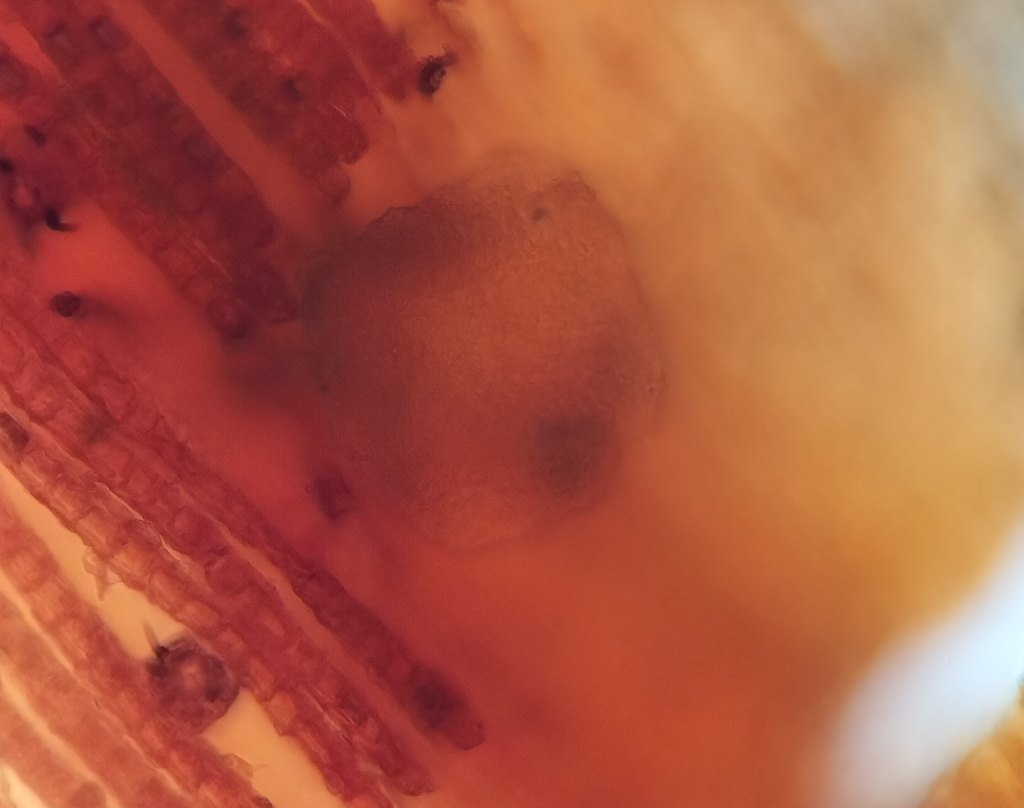
Both fungi produce fruitbodies less than 250 microns in diameter. I have failed to visualise good material of B. cuneifera on P. formosum despite the certainty of its presence in a sample kindly sent to me by Dr Döbbeler. It may take many hours of repeated screening of leaves from many different shoots to identify suitable fungal material. A putative Gloeopeziza sp. (between lamellar zone and lamina), Epibryon interlamellare (ubiquitous) and a possible Bryomyces sp. (lower leaf zones near or within sheaths) were observed. Fruitbodies were found (see below) but they were devoid of ascospores in this case.

References
- Döbbeler, P. (1978). Moosbewohnende Ascomyceten I. Die pyrenocarpen, den Gametophyten besiedelnden Arten. Mitt. Bot. Staatssamml. München, 14: 1-360.
- Döbbeler, P. (1985). Ascomyceten auf Polytrichaceen. Sydowia, Ann. Mycol. Ser. II., 38: 41-64.
- Döbbeler, P. (2019). Tremella bionectriae sp. nov. – the first hyperbryophilous fungal species. Nova Hedwigia, 109(3-4): 369-378.
 Bryophilous fungi