George R. L. Greiff, 23 October 2025
In 2024, Peter Döbbeler and I published a paper in Nova Hedwigia where we described a new genus and species based on Scottish and Welsh material of a hypocrealean ascomycete fungus found on the liverwort, Lejeunea patens. The new fungus, called Endoantria benetecta, is part of a remarkable group of so-called perianthicolous species. These fungi are found within specific leafy liverwort perianths, protective maternal coverings that surround developing sporophytes, and they hook up to the liverwort parent-offspring nutrient transfer system and kill the host sporophytes before they mature. The fruitbodies of the fungi, which are often yellow, orange or red in colour, develop on the inside of the perianth and usually bore a hole through the wall to release their spores. These perianthicolous species are some of my favourite bryophilous ascomycetes as they have such specialised and fascinating biology.

The BBS Isle of Arran (Scotland) meeting in July 2018 and the lead-up
Not long after I started looking at bryophilous ascomycetes, I went on my first bryological expedition outside of familiar south England. It took me right out of my comfort zone, as I was accustomed to searching for tiny ephemeral bryophytes in calcareous habitats and epiphytes in relatively dry woodlands. The size and diversity of more acidophilic species along the Atlantic coast of Scotland was almost overwhelming. I recall taking what I thought would be rare, tall liverworts to more knowledgeable bryologists several times, only to be informed that I had collected Diplophyllum albicans, again! In my local area, D. albicans usually didn’t get much taller than Fissidens taxifolius… I learned a lot of new bryophytes from diverse habitats, including montane species and those from humid forests. It was in one of the latter that I noticed Endoantria benetecta for the first time.
From late 2017 into 2018, I developed a strong interest in bryophilous ascomycetes, which took over from lichens and lichenicolous fungi. I had tried my hand at a variety of natural history pursuits, starting with bryophytes, going into lichens and lichenicolous fungi, with brief forays into freshwater algae as well as ascomycetes on dung and on vascular plants. My mentor, Colin Pope, while supportive of this exploration, advised me to specialise, particularly if I wanted a career in biodiversity research. While I found lichens and lichenicolous fungi to be very interesting, I hit a wall only passable by dedicated specialisation. And I did not want to give up my beloved bryophytes. I had found many new records of lichenicolous fungi in 2017 and 2018, both for the Isle of Wight and one for England (Myxophora leptogiophila on Collema s.l.), and I started to wonder if bryophytes also had fungal parasites. After finding a few species over the years and not really getting anywhere with most of them, I started to come across some of the more charismatic bryophilous ascomycetes on epiphytic liverworts in the autumn of 2017.
I distinctly recall finding Bryocentria hypothallina on Metzgeria furcata on a beech tree trunk for the first time in Beechwood Copse (aptly named) in Godshill on the Isle of Wight. It was super exciting, since B. hypothallina was a new record for the British Isles and the fungus had only been described in 2015. That made me catch the bryo-fungus fever, and I began searching for other species on other epiphytic liverworts. I remember finding Pithyella chalaudii (syn. P. frullaniae) in Brighstone Forest, followed shortly by Bryocentria brongniartii and Periantria frullaniae (syn. Calonectria frullaniae), all on Frullania dilatata. All three were new for the Isle of Wight and had very few or no British and Irish records. Finding Bryocentria octosporelloides in August 2018 sealed the deal for me, however, as this fungus on the tiny leafy liverwort, Myriocoleopsis minutissima, had been described as new to science from a single Spanish collection only a few months prior. This early work put me in touch with Dr Peter Döbbeler, the world expert on bryophilous ascomycetes, particularly pyrenomycetous species, and Peter’s support and mentorship made any work that followed possible.
While I was on the Arran meeting a few months later and we went into the beautiful Glenashdale Wood, my bryophilous fungi radar started beeping and I started to look at epiphytic liverworts for fruitbodies. Almost immediately, I detected a lovely orange fungus on Frullania tamarisci, which turned out to be Filicupula suboperculata. At the time, there were fewer than half a dozen published records of F. suboperculata worldwide, and the collection was sequenced by a group of continental European researchers interested in the group of fungi it belongs to, the bryoparasitic Pezizales. Not long after spotting the Filicupula, someone casually shouted that they had found Lejeunea patens and to add it to the site’s recording card. I had never seen L. patens before, so rushed over to admire it. As I studied it, I noticed that the perianths had tiny orange spots on their apices, and I remarked that they resembled the perianthicolous Periantria frullaniae, which I had seen not long before. A very experienced bryologist dismissed that the orange could be a fungus, and said that L. patens perianths were often that colour and that it was probably the sporophyte coming out. Sceptical, I almost did not collect the specimen, but decided I’d check it for myself on the off chance it turned out to be a fungus after all.
When I arrived back home some days later, I examined the orange objects in the L. patens perianths under the compound microscope. It immediately became clear that the orange objects were fungal fruiting bodies, and I was able to see both asci and ascospores. I trawled through Peter Döbbeler’s papers and found that Nectria lankesteri seemed to be the closest match. N. lankesteri was on a host in the family Lejeuneaceae, but was reported to grow on leaves, not in perianths, and it had only been found in Costa Rica. I contacted Peter and he was sceptical, asking to examine the collection himself. After he had examined the specimen, he confirmed that it matched nothing else he had seen should be described as a new species. It was stunning news, but there was a caveat. The small specimen I had collected was not sufficient to be a type specimen. Additional material was needed to complete the description and have enough for future studies. I needed to find the fungus again.

Return to Arran, July 2022
I did not refind Endoantria benetecta until four years later. This time included my entire undergraduate degree, much of the covid pandemic, and a lot more work on bryophilous ascomycetes generally. After years of delays, I finally managed to set up a hair-brained scheme to get back to the Isle of Arran and find the fungus from where I had collected it before. I planned to visit two sites, a small bit of woodland beside a river at Glenloig near the centre of the Island, and Glenashdale Falls. The plan was to hire a bike and cycle to the sites, as I recalled the relevant parts of the Island being rather flat (how wrong I was…) Logistically, the trip was supposed to involve a few steps but was not too complicated, as I had to get to Bristol Airport, fly to Glasgow, take a train to Ardrossan and then the ferry over to Arran. If only it had been this easy.
On the day of travel, I had to book a taxi to get me to Bristol airport at 4 a.m. as my flight was one of the first to head off in the morning at around 6 a.m. Once I reached the airport, the place was heaving with people. The queue for security was out the door, into the terminal building, outside again, and back into another part of the terminal! And it was not moving quickly. I started to worry that I wouldn’t make my flight. The queue sluggishly moved on and time was ticking. I got through security and ran to the boarding gate with moments to spare, the plane already full. I breathed a sigh of relief. I made a mental note not do this again during peak holiday flight season. But the journey had only begun.
I had heard news the day before that there was a rail strike planned for the day I was travelling. And it was going ahead. My simple train from Glasgow to Ardrossan was no longer in operation, so I had planned a contingency bus journey. It involved about six different buses that eventually got me to Ardrossan in the afternoon. I had also just missed one of the ferries over to Arran, so had to wait around for the next one. By the time I finally got to Arran in the afternoon, I had been travelling for ten hours straight. I hired a bicycle in Brodick and began my journey to Glenloig. Almost instantly, I was hit with the undulating road that never ceased producing hills all the way to the site. Two sweaty hours later, I finally made it to the site. I hid my bike near the small, empty gravel car park and stepped into the wood. And realised this was not the good site for E. benetecta. It was limited to a stream flanked by trees rather than a more extensive woodland. There were no paths and access was limited to around ten square meters. Disappointed with myself for wasting time, I gave myself an hour to poke around the site. I screened the epiphytic bryophytes and found some bryophilous fungi – notably a thyriothecium-producing species on moribund Pellia cf. neesiana. Lejeunea patens was around as an epiphyte, but I didn’t see any evidence of E. benetecta. Then, just as I was about to give up, I noticed a patch of L. patens on the lower limb of a tree close to the water. Orange flecks greeted me from the other side of my hand lens. I had found it. The population was small and would not be enough for a type specimen, but at least it had been there. Triumphant but exhausted, I then cycled for almost three hours until I reached my accommodation in Lamlash.
The next morning, I cycled down to Whiting Bay for a visit to Glenashdale Falls, which I knew would be the place I would find the type collection. If I had found the species there before without much trouble, it would surely be a simple matter to find a good specimen to be the reference material of the species. It was an auspicious day, 28 July 2022, exactly four years after I had found the species at the same site for the first time. I stopped for breakfast at a cafe near the entrance of Glenashdale Wood and chatted to the owners. They informed me of a nice looping walk from a northern entrance that would lead me down the way I had come up during the BBS meeting. I should have asked if I could leave my bike at their cafe, but instead I trawled it along the walk with me. As I passed some of the minor streams coming through the site, it did not take long to find some sizeable populations of E. benetecta. I took a lot of time to study the populations there, noting that infections were not homogeneous throughout even a single host patch. Clusters of infected perianths bearing orange perithecia were adjacent to green perianths bearing healthy sporophytes. L. patens and Frullania tamarisci were abundant in the site, the former infected by E. benetecta and the latter with Filicupula suboperculata, which was common. Both fungi were easy to find. I managed to collect a reasonably large specimen to serve as the type from an otherwise very large patch on a sycamore tree (Acer pseudoplatanus). After a slow walk through the site, stopping to admire the waterfalls of the main river, I headed back to the cafe for lunch. The journey was a success.
Analysis and conclusions
After getting home and studying the new collections, I discovered that both sexual and asexual reproductive structures were present on E. benetecta. The sexual perithecia were produced in the perianths, while the asexual conidia were formed on the lower parts of the outer perianth walls. Perhaps local spread by conidia could account for the patchy distribution of E. benetecta infections in Lejeunea patens populations, but we have no evidence that these conidia can infect host plants. I split the large collection, sending half of it to Peter Döbbeler in Munich to be the isotype, while the holotype was sent to the Royal Botanic Garden, Edinburgh herbarium. I then obtained a loan from the BBS herbarium in Cardiff(Amgueddfa Cymru – National Museum of Wales) and screened nearly 100 herbarium specimens of British and Irish Lejeunea species for E. benetecta infections. Surprisingly, I found none, indicating that bryologists probably ignore the odd-coloured material in favour of plants with typical, green perianths. A chance encounter in the summer of 2023 near Sgwd Yr Eira, a wonderful waterfall in Bannau Brycheiniog (the Brecon Beacons) in Wales led to another collection of E. benetecta on a L. patens population on a hazel (Corylus avellata) tree in the mist zone created by the waterfall. In 2024, after taking time to fully describe the species and get some molecular data from it and the related Periantria frullaniae, E. benetecta was formally described.
After it was published, I found another record of E. benetecta near Ardtornish in west Scotland in September 2024. I was rather surprised, however, not to find very much of it despite L. patens not being uncommon in the area. In 2025, I was alerted to a record of E. benetecta from Northern Ireland by Dean Mac Cú Uladh. Dean subsequently discovered multiple additional populations across Northern Ireland, bringing the total number of world records of E. benetecta to around ten. It is surely overlooked. Any additional records would be most welcome. I’m sure the story of Endoantria benetecta will continue into the future.
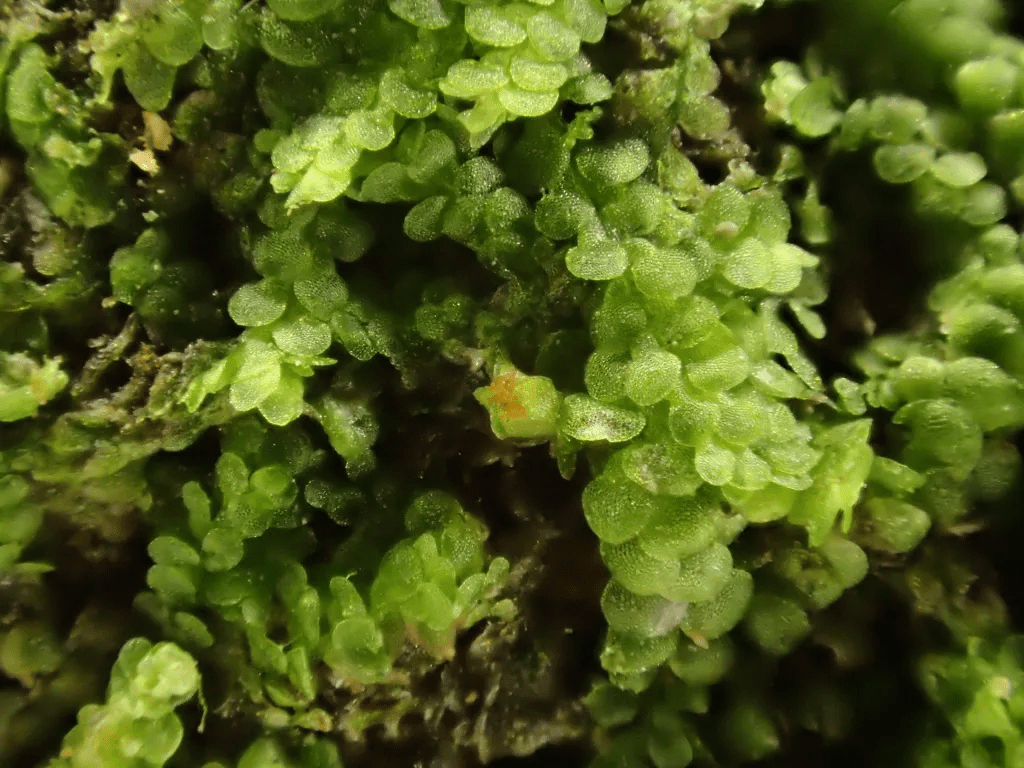
 Bryophilous fungi